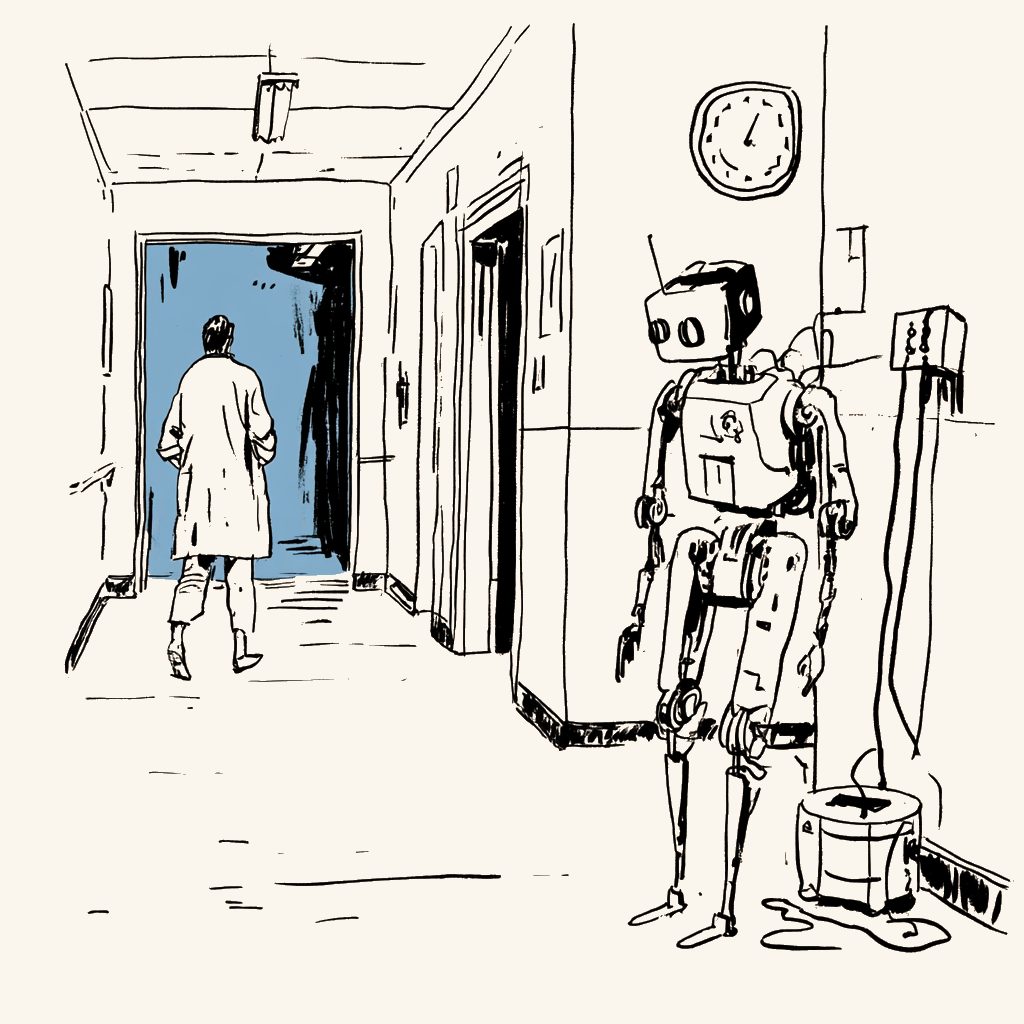
The Empty Hands
What today’s humanoid robots can and cannot take off the healthcare rota — what that does to a facility’s margin, and what would have to change
The demand case for a machine that can work in a hospital or a care home writes itself. Europe is short of the people to staff its healthcare facilities, the shortage is worsening, and the hardest posts to fill are the “3D” ones — dull, dirty and dangerous: night portering, cleaning, continence and toileting, lifting and turning frail bodies. If a humanoid robot could take that work, it would relieve the single most binding constraint in the sector. The pull is real, and it is why every large operator now fields the question from its board.
The supply case is where the discipline is required. A humanoid is a physical body, and the value it can create is bounded by what that body can actually, safely, reliably do — not by a demonstration video and not by a maker’s roadmap. So this begins with what the manufacturers themselves publish about their machines. From there it asks the one question an investor in a facility needs answered: which of the routines on the rota can a humanoid take today, which will it take next, and which must it learn to take before any of this is transformative rather than incremental — and what each of those does to EBITDA.
The tasks people least want to do are, almost exactly, the tasks a humanoid can least do. That inversion, not the demand, is the whole investment question.
The finding is a hard inversion. The work a humanoid can do today is the light logistics around care; the work that is hard to staff, injury-prone and expensive is hands-on care itself — and that is precisely the work no shipping humanoid can safely perform. Until the body can lift a person, work near water, and be certified safe in contact with a frail one, the case is augmentation, not replacement. This maps where that line sits, where it would have to move, and what the makers and the facilities each need to do to move it.
— Corryk
In brief
One — the demand is certain; the addressable work is not. Europe faces a projected shortfall of some four million health and social-care workers by 2030, concentrated in the hardest-to-staff manual roles, where turnover runs at a quarter to a third of the workforce a year. But the labour a humanoid can offset is a narrow, structured slice — portering, delivery, monitoring — not the hands-on care that drives the shortage. The addressable wedge is a fraction of the ~55–65% labour cost base, and it is not the part that is hard to fill.
Two — on what the makers publish, no humanoid can do the hard work. Across fifteen leading machines, OEM-published carry payloads top out at ~25–30 kg — a box-handling rating, not a patient-handling one — against a 60–90 kg adult; runtimes are 2–5 hours; none publishes safety certification for care-contact use; and only one is sold explicitly as a care robot, with a handful more claiming a future care ambition. The most-watched machine, Tesla’s Optimus, remains in launch-phase development.
Three — the near-term case is augmentation, and the gaps are nameable. At a fully-loaded ~€18–28 per working hour today, a capable humanoid costs at or above the European care worker it would offset; the economics turn only on a 2029–2032 cost curve. The value that accrues now is indirect — agency-cost avoidance, retention, injury reduction. Between augmentation now and substitution later sits a defined list of capability gaps — payload, endurance, safe contact, wet tolerance, dexterity, reliability, and, in Europe, data-protection — each with a clear owner.
A humanoid can take the dull logistics around care today, but not the dirty and dangerous care work that is hard to staff — so the near-term return is retention and agency savings, and the transformative return waits on a defined set of gaps that the makers must close and the facilities must prepare for.
A note on the evidence
Three disciplines govern what follows. First, every robot specification is taken only from the manufacturer’s own published material — its website, spec sheet or official release — so capability is judged on what makers stand behind, not on aggregated claims. Second, the healthcare figures are European and current, from primary workforce and cost sources, and all monetary values are in euros (non-euro sources converted at ECB reference rates, mid-2026: €1 ≈ $1.14 ≈ £0.85). Third, the task-substitution ratings, the addressable-wedge split, the per-hour build-up and the gap roadmaps are Corryk analytical frameworks and estimates, flagged as such. Capability is dated July 2026 and will move — the point is the method, not a frozen scoreboard.
The work no one wants
1 · Four million short — and leaving
The labour constraint in European healthcare is structural and widening. The World Health Organization’s European region projects the health and social-care workforce gap will grow from roughly 1.8 million unfilled posts in 2022 to about four million by 2030 if unaddressed, the largest component of it nursing and care assistants.
A projection of a shortage is one thing; a workforce voting with its feet is another, and harder to argue with. In residential and home care — the front line of the manual work — annual turnover runs from a fifth of staff in Denmark to nearly a third in Ireland, with the United Kingdom and France in between. This is not a labour market that is merely tight; it is one people actively leave, faster than almost any other, and the reasons they give are the reasons the work is unpleasant.
Turnover on this scale is itself a cost — every point of it is recruitment, induction and the lost productivity of a half-trained replacement — and it is the clearest revealed measure of work people do not want to keep doing. It is also the clue to where a machine could help without displacing anyone: not by replacing the carer, but by removing the parts of the job that drive the carer out.
2 · Where the posts sit empty, and who is left
The churn shows up as empty posts. In residential elderly care, vacancy runs from 7% in the UK to a striking 21% in Denmark — against roughly 2% in the wider economy. Hospital vacancy is lower in absolute terms but rising fastest in the Netherlands and the Nordics, where the tight labour market bites first.
And the workforce that remains is ageing toward the exit. Among specialist doctors — the top of the skill ladder, and the slowest to replace — the share aged 55 and over runs from 14% in the UK to 44% in Italy; across the EU, roughly 37% of care workers are already aged 50 to 64. The pipeline behind them does not refill the gap: in much of Europe the recent fix has been imported labour, a tap now constrained by tighter immigration and, in the UK, by the post-Brexit collapse in EU registrations.
Put the three together — a widening shortfall, a workforce that leaves the manual roles fastest, and a remaining cohort ageing toward retirement — and the demand for any machine that can take real hours off the rota is as strong as it looks. The question is only whether the machine can take the right hours.
3 · The unwanted-work map
Not all of the rota is equally unwanted, and not all of it is equally automatable — and the two do not line up. Ranking the work by how much staff dislike it, and setting that against what a machine could plausibly take, produces the central tension of the whole thesis in a single view.
Exhibit 5 · The unwanted-work map: highest pain, lowest addressability
Healthcare’s physical work, ordered by how strongly it is disliked. The work people most want to hand over is the work a humanoid can least take.
| The work | Why people avoid it | Humanoid-addressable today |
|---|---|---|
| Continence & intimate personal care | Dirty, frequent, dignity-sensitive; low-paid; the task carers most cite for leaving | Low |
| Patient handling: transfers, turning, falls | Dangerous, injury-prone, two-person work — the top source of musculoskeletal injury | Low |
| Night care & 1:1 observation | Anti-social hours, fatigue, dementia distress, expensive agency cover | Monitoring only |
| Waste, soiled linen & portering | Dirty, heavy, repetitive, low status | Medium (transport) |
| Hospital internal logistics | Repetitive, walking-heavy, low status; miles per shift | High |
| Sterile processing (CSSD) | Dirty instruments, sharps risk, high-consequence, chronically understaffed | High (fixed cells) |
| Lab & pharmacy throughput | Repetitive, error-stress, shortage-prone, night rota | High (fixed cells) |
| Veterinary technician work | Bites and scratches, euthanasia support, emotional load, low pay for the skill | Low–medium |
Corryk synthesis of the care and facility task inventory and workforce-pain signals (Skills for Care; DREES; EU-OSHA; sector reporting). Ordered by dislike; addressability from the OEM capability record (Part II).
Read down the table and the inversion is stark. The three most-disliked bands — intimate care, patient handling, night care — are the least addressable; the addressable work — logistics, sterile processing, lab throughput — sits lower down the list of things staff want to be rid of, and much of it is already served by fixed and wheeled machines rather than humanoids. The work people most want to hand over is the work a robot can least take. Everything that follows is an attempt to price that gap.
4 · Where the labour cost sits
Labour dominates the cost base of every healthcare facility — about 55% of revenue in a care home, and higher in hospitals: personnel is roughly 61% of total cost in German hospitals and 57–60% in French ones. That is the number that makes the robot question irresistible to a board. But the headline is misleading about what a machine can reach.
Of the labour block, the largest slice is hands-on personal care — the work that is both hardest to staff and, as Part III shows, hardest to automate. Registered-nurse hours are clinical and licence-protected; in Germany they are now carved out of the hospital tariff and reimbursed at cost, a structural feature any margin model must respect. Property, rent and finance — a fifth of revenue — are fixed and untouched by any robot. What is left for a humanoid to plausibly touch is the ancillary and logistics band: catering, domestic, laundry and transport work, perhaps a tenth of revenue. The addressable target is real, but it is a wedge, not the wall.
What the machines can do
5 · The specification reality
The most important discipline in this sector is to separate what a robot is from what it is said to be. The table below reports only figures each manufacturer publishes itself. Blank cells are specifications the maker does not disclose.
Exhibit 7 · General-purpose humanoids with potential healthcare applications
Only OEM-published figures, as of 13 July 2026. “—” = not published by the maker. “Readiness” and “Care positioning” reflect each maker’s own characterisation — not standardised categories, so treat as indicative rather than comparable grades. Prices in the maker’s own currency. Most are industrial or household general-purpose robots; none has a published medical-device clearance or routine clinical deployment.
| Robot | Readiness (OEM) | Carry payload | Height / weight | Runtime | Care positioning | Price |
|---|---|---|---|---|---|---|
| Agility Digit | Deployed (logistics) | ~16 kg | ~175 cm / ~64 kg | ~4 h | None | RaaS |
| Figure 03 | Production ramp | 20 kg | ~173 cm / 61 kg | ~5 h | Home-assist | — |
| Apptronik Apolloa | Pilots (Apollo 2 now) | 25 kg | 173 cm / 73 kg | ~4 h, hot-swap | Future care | — |
| Boston Dynamics Atlas | Field pilots (Hyundai) | 30 kg (50 peak) | — / — | ~4 h | None | — |
| UBTech Walker S2 | Mass production | 15 kg | — / — | —b | None | — |
| Humanoid HMND 01 Alpha Wheeled | Contracted deployment (industrial) | 15 kg | 220 cm / 300 kg | ~4 h | None | — |
| 1X NEO | Pre-order (ship 2026) | 25 kg (arm ~8 kg) | 168 cm / 30 kg | ~4 h, self-charge | Home-assist | $20,000 / $499·mo |
| Fourier GR-3 | Available “Care-bot” | — | 165 cm / 71 kg | ~3 h, hot-swap | Explicit care | — |
| Unitree G1 | Shipping (research) | ~2 kg arm (3 EDU) | 132 cm / ~35 kg | ~2 h | None | from $13,500 |
| Unitree H1-2 | Shipping (research) | —c | 178 cm / ~70 kg | —c | None | — |
| Unitree R1 | Shipping (research) | — | — / ~25 kg | — | None | from $4,900 |
| Sanctuary Phoenixd | Superseded (Gen 8 wheeled) | 25 kgd | 170 cm / 70 kgd | — | None | — |
| AGIBOT A3 | Available | — | — / — | — | Future care | — |
| NEURA 4NE1 | Pre-order | — | — / — | — | Future care | — |
| Tesla Optimus | Development | — | — / — | — | Home-assiste | — |
Sources: agilityrobotics.com, figure.ai, apptronik.com, bostondynamics.com, ubtrobot.com, thehumanoid.ai, 1x.tech, fftai.com, unitree.com, sanctuary.ai, agibot.com, neura-robotics.com, tesla.com (accessed 13 July 2026). Carry payload is a box-handling rating, not a patient-handling or dynamic-lift certification. aApollo figures are Gen 1; Apptronik is advancing Apollo 2. bWalker S2’s ~3-min figure is autonomous battery-swap, not runtime. cH1-2’s 864 Wh is battery energy; arm payload undisclosed — the 7 kg rating belongs to the newer H2 Plus. dPhoenix figures are the sixth-generation bipedal model; Sanctuary’s current Gen 8 is wheeled. eOptimus positioning is Tesla/Musk guidance, not a shipped specification. Not tabled: Unitree H2 Plus, UBTech Walker C1, and NEURA MiPA (a wheeled care robot, ~€9,999, late 2026). *1X also publishes a static “lift 70 kg” figure alongside an 8 kg arm payload; it is not a dynamic patient-handling rating.
Two patterns matter for a care investor. Only two makers are positioned for care at all — Apptronik, which names “elder care” as a future application, and Fourier, whose GR-3 is a “Care-bot” for companionship and rehabilitation; the rest are built for logistics and manufacturing, and a robot designed for a warehouse does not become a care worker by being pointed at a ward. And the machines nearest to commercial use — Agility’s Digit, UBTech’s Walker — are tote-movers and factory hands, not carers.
The most-watched entrant is Tesla’s Optimus. Tesla has said the third-generation machine is its first designed for mass production, with a pilot line under construction at its Fremont plant and a second planned in Texas, and has shown factory units gathering training data; Elon Musk has floated a price of roughly €17–26k at volume and a production start in 2026. Tesla frames Optimus as central to its shift to a “physical AI company,” reusing the vision-and-neural-network stack from its self-driving programme — its clearest advantage over pure-play rivals, which lack that fielded real-world dataset. It remains pre-production, and its strength is as much about manufacturing scale and an AI backbone as any demonstrated care capability; for a healthcare buyer, it is a machine to watch, not yet one to plan around.
6 · The payload gap and the shift
Two published measures decide whether a humanoid can do the hard care work, and both fall short of it. The first is payload. Hands-on care is, physically, the handling of a 60–90 kg deformable, off-centre human body; the best OEM-published carry figure is 30 kg.
Not one machine reaches even half the weight of the person a transfer requires, and the gap is not incremental — it is a factor of two to three, against a load that is soft, mobile and safety-critical rather than a rigid box. This single constraint removes every patient-handling task from the near-term set, and it is why the two-person manual-handling rota — the most injury-prone work in the building — cannot be handed to a robot.
The second is endurance. A care shift is eight or twelve hours; published runtimes are two to five, and only two makers publish an autonomous battery swap that would allow continuous running.
A machine that must stop to charge every few hours does not simply work fewer hours; it needs a charging routine the rota has to plan around, and a second unit to cover it. Neither the weight it can lift nor the hours it can run yet matches the job — and no maker publishes a human-collaboration safety certification that would let it work in contact with a frail person at all. These are not reasons to dismiss the category; they are the specific things that have to change, and Part V returns to them.
The routine map
7 · Five blockers, routine by routine
What makes a healthcare routine automatable is not how unpleasant it is but how many of five physical blockers it clears: the need to bear a human’s weight; intimate contact governed by consent and dignity law; a clinical licence reserving the act to registered staff; an unstructured, cluttered, human-shaped space; and the manipulation of deformable objects — cloth, skin, soft tissue. A routine is addressable to the degree it sheds these. Mapping the rota against them sorts the work cleanly into three bands.
Exhibit 10 · The routine map — five blockers, three verdicts
✓ = the blocker is not present for this routine. The verdict follows the count of blockers cleared, discounted for the unstructured, safety-critical care floor.
| Routine | Weight | Consent | Licence | Structured | Rigid object | Verdict |
|---|---|---|---|---|---|---|
| Portering, supply & waste transport | ✓ | ✓ | ✓ | ~ | ✓ | Today |
| Meal & drink delivery | ✓ | ✓ | ✓ | ~ | ✓ | Today |
| Hydration rounds & monitoring | ✓ | ✓ | ✓ | ~ | ✓ | Today |
| Reception, wayfinding & information | ✓ | ✓ | ✓ | ~ | ✓ | Today |
| Ward stock & medication delivery | ✓ | ✓ | ✓ | ✓ | ✓ | Today |
| Cleaning & environmental services | ✓ | ✓ | ✓ | ✗ | ~ | Near-term |
| Laundry & bed-making | ✓ | ✓ | ✓ | ~ | ✗ | Near-term |
| Waste & soiled-linen handling | ✓ | ✓ | ✓ | ~ | ✗ | Near-term |
| Vitals capture | ✓ | ~ | ~ | ✓ | ~ | Near-term |
| Companionship & emotional support | ✓ | ✓ | ✓ | ✗ | ✓ | Near-term |
| Walking / mobility assistance | ~ | ✗ | ~ | ✗ | ✗ | Not near-term |
| Transfers, turning, hoisting, falls | ✗ | ✗ | ~ | ✗ | ✗ | Not near-term |
| Bathing & showering | ~ | ✗ | ✗ | ✗ | ✗ | Not near-term |
| Toileting & continence care | ✓ | ✗ | ✗ | ✗ | ✗ | Not near-term |
| Dressing / undressing | ✓ | ✗ | ✓ | ✗ | ✗ | Not near-term |
| Feeding assistance | ✓ | ✗ | ~ | ✗ | ✗ | Not near-term |
| Wound care & dressing changes | ✓ | ✗ | ✗ | ✗ | ✗ | Not near-term |
| Medication administration | ✓ | ✓ | ✗ | ✓ | ✓ | Licence-gated |
Corryk analytical framework applied to the OEM capability record (Exhibit 7) and European care-handling regulation (CQC Reg 10/11; EU manual-handling directives; national two-person handling rules). Ratings are judgement, not certification.
The map confirms the inversion of Exhibit 5 in physical terms. The green band — addressable today — is the light logistics of care: moving things, delivering things, watching. It is the dull third, and it is real work that pulls staff off the floor. The red band is the entire body of hands-on personal care and patient handling — the dirty and dangerous thirds, blocked at once by physics, by consent law and by the licence — and it is exactly the work that is hard to staff, injury-prone and high-turnover. A machine can take the errands that interrupt a carer; it cannot yet take the care that exhausts one.
One entry runs the other way, and it is worth flagging because it cuts against the reflex. Companionship reads as the hardest thing to automate, yet it clears every physical blocker on the map, and simpler, non-humanoid “social robots” already deliver a version of it in eldercare. The resistance there is about adequacy and ethics, not capability — it is the one piece of care work that is emotional rather than physical, and so among the more addressable, not the less.
8 · The addressable wedge, and the rest of the market
Translated into hours, the green band is a modest share of a facility’s labour, and it does not overlap the shortage.
An honest reading puts the today-addressable share at roughly a sixth of care-facility labour hours, another sixth reachable near-term as augmentation, and the remaining seventy per cent — the hands-on and clinical core — beyond a humanoid’s near-term reach. That wedge is the ceiling on the near-term substitution case, and it sits on the least valuable, least scarce hours.
One further point of context an investor should hold, precisely because it is not the subject here. The logistics and cleaning work in the green band is already being automated in healthcare — but overwhelmingly by machines that are not humanoids. Wheeled delivery robots move medicines and linen through hospital corridors; sealed workcells dispense drugs and compound sterile IVs; fixed tracks run the clinical laboratory; purpose-built mobile bases disinfect and scrub floors. In animal husbandry, the proof-points are starker still — more than 43,000 robotic milking units are installed worldwide — all of it fixed automation, none of it a humanoid.
Exhibit 12 · Where healthcare’s physical work is already automated — and why not by humanoids
Context, not the focus. These are the settings where embodied automation earns money today; almost none is a humanoid, because a structured space with rigid objects rewards a fixed or wheeled machine.
| Setting | Winning machine today | Why not a humanoid |
|---|---|---|
| Intralogistics (meds, linen, meals) | Wheeled delivery robots | Bulk transport rewards a cart on wheels; a walking body adds cost, not capability. |
| Pharmacy dispensing & IV compounding | Sealed fixed workcells | Sterility and containment require a barrier a roaming robot would break. |
| Clinical / pathology laboratory | Fixed track automation | Rigid tubes on rails; structure wins decisively over general dexterity. |
| Sterile processing (CSSD) | Fixed vision / robotic cells (emerging) | Standardised trays in a fixed station; under-penetrated, but not a biped’s job. |
| Environmental services | Purpose-built mobile bases | Disinfection and scrubbing are solved by single-purpose wheeled units. |
| Dairy milking / vivarium care | Fixed robotics (43,000+ units) | The animal is channelled into a fixed stall or cage — the definitive structured-husbandry proof. |
Corryk synthesis of public deployment evidence. Included to distinguish the humanoid question from the broader embodied-automation market; vendors and volumes noted only as market structure.
The point is not that the humanoid loses; it is that the humanoid’s distinctive advantages — a human form that fits human spaces, uses human tools, climbs stairs and works where the environment cannot be re-engineered — are exactly what these structured settings do not need. The humanoid’s case is the unstructured ground: the care floor, the cluttered ward, the home. That is where the scarce, valuable, hard-to-staff work is — and it is also, not coincidentally, where the body is not yet good enough. The near-term embodied-robot revenue in healthcare is in the fixed and wheeled forms; the humanoid is a bet on the harder, later, larger prize.
9 · The veterinary parallel
Healthcare labour scarcity is not only human. Veterinary medicine runs its own workforce crisis — in the UK the annual inflow of new registrants fell by around two-thirds after Brexit removed automatic recognition of EU qualifications, vets have moved on and off the shortage-occupation list, and veterinary nurses report leaving over pay, stress and burnout at rates that worry the profession. The demand pull for a machine is, if anything, as acute as in human care.
The veterinary clinic is worth a moment because it tests the thesis from the other side. It removes one blocker — there is no human-dignity or consent statute governing a dog — and yet it does not become addressable, because it adds a harder one: the patient is a live, frightened, unpredictable animal that moves, resists and bites. Restraining and handling a struggling animal is a deformable-manipulation problem on a moving, non-compliant subject — if anything more difficult than a compliant human transfer, not less. The softer legal regime does not confer physical addressability; the physics and the live agent decide it.
Exhibit 13 · The veterinary parallel — the same inversion, with a live animal
Veterinary work sorts the same way as human care, for the same physical reasons — and the animal-contact core is among the hardest work in all of healthcare, despite no consent law.
| Veterinary work | Dominant blocker | Verdict |
|---|---|---|
| Kennel cleaning, waste, laundry, sterilisation | Structured, no animal contact | Today (fixed automation usually wins) |
| Sample & supply logistics | Structured transport | Today |
| Feeding & husbandry rounds | Semi-structured, light contact | Near-term |
| Restraint for examination or treatment | A live, resisting, deformable animal | Not near-term |
| Grooming (de-matting, nail trim, scissoring) | Fine dexterity on an anxious moving animal | Hardest of all |
| Euthanasia & end-of-life | Clinical licence, and a present, grieving owner | Not near-term — a licensed clinical act, emotionally central |
| Diagnostics & lab work | Structured, rigid samples | Already automated — fixed analysers, not humanoids |
Corryk framework applied to European veterinary workforce strain (RCVS/BVA; UK EU-registrant inflow down ~68% post-Brexit) and the five-blocker logic, extended with a sixth variable: the unpredictable live animal.
The lesson reinforces the human-care map rather than complicating it. Across both, the addressable work is the structured, no-contact logistics — and even there a fixed or wheeled machine usually beats a humanoid. The unaddressable work is direct handling of a living body, human or animal, and grooming an anxious animal may be the single hardest physical task the sector contains. For an investor with exposure across human and animal health, the humanoid question has one answer in both: augmentation of the logistics now, the contact work later, and the same set of gaps standing in the way.
The EBITDA case
10 · Cost per hour, and the augmentation thesis
Even where a humanoid can do the work, the economics today do not favour replacement. Built up from published hardware and service costs, a capable machine runs at roughly €18–28 per working hour fully loaded — depreciation on a €60–175k asset over a short life, plus maintenance, integration and, decisively, the remote-operator time that current “autonomous” units still require.
That places the robot at or above the €12–21 European wage of the care and ancillary staff it would offset, and above the agency rate it might displace — before accounting for the human staff still needed alongside it for everything in the red band. The much-quoted €5–10 per hour is a 2029–2032 projection contingent on cheaper units, longer lives, higher utilisation and minimal teleoperation — none demonstrated in a care setting. On 2026 economics, a straight-substitution model is negative to neutral for most facilities.
Which is why the credible near-term case is augmentation, and the evidence for it is unusually clear. The best study to date — a Japanese nursing-home panel — found that adopting physical-assist and monitoring robots was associated with higher employment and retention, not job cuts: robots absorbed specific physical tasks and let scarce carers reallocate toward hands-on work, with lower restraint use and fewer pressure ulcers. The machine did not replace the worker; it kept the worker.
The value is retention, not headcount.
On the record to date, robot adoption in nursing homes raised staffing and retention rather than cutting it. For an operator running a quarter-to-a-third turnover (Exhibit 2) and paying an agency premium to cover gaps, that channel — not FTE elimination — is where the near-term EBITDA actually sits.
11 · Levers and first adopters
Where value does accrue near-term, it accrues through indirect levers, ranked here by how well the evidence supports them.
Exhibit 15 · How the EBITDA actually accrues
Near-term value levers by confidence. The first four require no net headcount reduction to create value.
| Lever | Confidence | Mechanism |
|---|---|---|
| Agency-cost avoidance | High | Robot coverage of predictable night/logistics tasks reduces reliance on premium temp cover — a direct margin benefit, no headcount cut required. |
| Retention & recruitment | High | Removing 3D drudgery lifts retention (the empirical channel), saving recruitment, induction and churn cost against a quarter-to-a-third turnover. |
| Injury & sickness reduction | Medium | Offloading portering and transport lowers musculoskeletal injury, sickness cover and insurance. |
| Productivity / occupancy support | Medium | Freeing carers from constant interruption lets scarce staff cover more residents at quality, supporting occupancy without proportional hiring. |
| Direct wage substitution | Low | Genuine FTE removal needs whole shifts of automatable tasks and a robot cheaper than the wage — both are 2029–2032, not today. |
Corryk ranking synthesising the empirical record (nursing-home robot-adoption studies) and the cost build-up (Exhibit 14).
The first adopters follow from the economics. The facilities that can make a 2026 pilot pay are the large, scaled, private-pay operators — scale to amortise integration, margin headroom to absorb a cost that is neutral before it is accretive, and fee flexibility — not the publicly-funded homes and hospitals running on thin margins, for whom a break-even robot is a luxury. The sequence is pilot, then augment, then — only once the gaps close — substitute.
Closing the gaps
12 · The gap catalog
The payload and endurance shortfalls are the two most visible gaps, but they are not the only ones standing between augmentation and substitution. Collecting them gives a defined agenda — each gap nameable, each with a current status, and, in the next section, each with an owner. None is met today; each is a milestone an investor can track.
Exhibit 16 · The gaps between a humanoid and a care worker
The capability, safety and compliance gaps that must close for the red band to open. Status as published or observable, July 2026.
| Gap | What it blocks in healthcare | Status (2026) |
|---|---|---|
| Human lifting | Transfers, turning, falls response — the injury-prone core | Payloads ≤30 kg vs a 60–90 kg adult |
| Autonomous endurance | Any unsupervised full shift | 2–5 h; teleoperation-reliant |
| Safe human contact | Any physical-contact task with a frail person | No standard yet covers humanoids in patient contact; ISO 13482 predates them |
| Wet / biohazard tolerance | Bathing, toileting, continence, spills | Water rating rare and partial |
| Deformable dexterity | Dressing, laundry, bed-making, soft-tissue handling | Demonstrated, not reliable |
| Reliability / uptime | Any rota-critical role | Minutes-to-hours between interventions |
| Speed / cycle time | Throughput economics vs a human | Manipulation markedly slower than a person |
| Data-protection compliance (EU) | Any sensor-bearing robot in a bedroom or bathroom | GDPR + AI Act + MDR; largely unmet by US-built units |
| Liability & insurance | Operating unsupervised near patients | No actuarial base; fault model unresolved |
Corryk framework synthesising the OEM capability record (Part II), the safety-standards position, and EU data-protection law (GDPR, AI Act, MDR). The EU-compliance gap is specific to European deployment and is often overlooked in roadmaps built for other markets.
Two of these deserve emphasis for a European reader. The data-protection gap is not a footnote: a camera-bearing robot in a resident’s bedroom or bathroom triggers GDPR’s special-category rules, a mandatory impact assessment, and — where the robot influences care — the EU AI Act’s high-risk regime and possibly medical-device rules, all at once. A machine that is perfectly deployable in a home elsewhere can be structurally non-deployable in a European care setting without edge processing, consent frameworks and conformity assessment — a real cost and time-to-market gap the hardware specs never show. And the liability gap is one no insurer has yet priced: until the fault model for an autonomous machine harming a patient is settled, deployment near vulnerable people carries an open-ended risk.
13 · For the makers, and for the facilities
Every gap has two owners. The manufacturer has to close it. The facility has to be ready to use the machine when the gap closes — which means work that can start now, before a single robot is bought. The two agendas mirror each other.
Exhibit 17 · For the makers — what would close each gap
The engineering agenda that would move a humanoid from the logistics band into hands-on care — and the evidence a healthcare buyer should expect before deploying.
| Gap | What would close it | What a buyer should see |
|---|---|---|
| Human lifting | Force-controlled actuation rated for dynamic handling of a deformable >70 kg load | A rated, independently-tested safe patient-handling load |
| Endurance | Autonomous swap or charge, and longer-life packs | Runtime, swap time, and the real supervisor-to-robot ratio |
| Safe contact | Compliant, force-limited design certified to a human-collaboration standard | The certification itself — the single most valuable proof in care |
| Wet / biohazard | IP-rated actuation and cleanable, contamination-tolerant hands | An IP rating and a cleaning / decontamination protocol |
| Deformable dexterity | Reliable autonomous cloth and soft-tissue manipulation | An autonomous success rate and failure modes, not a highlight reel |
| Reliability | Design for mean-time-between-failure; treat hands as serviceable | Uptime and MTBF from real, named deployments |
| Data-protection (EU) | On-device processing, sensor masking, audit logging | A documented EU-conformity path (GDPR, AI Act) |
Corryk analytical framework. Directed at the capability and evidence standard a healthcare buyer should expect before deployment.
Exhibit 18 · For the facilities — a readiness checklist
What a hospital or care operator can do now, before buying anything, to be ready for the humanoid era — and to avoid paying for it prematurely.
| Readiness area | The move | Why now |
|---|---|---|
| Task audit | Map your rota against the five blockers; size the green logistics hours | Know your addressable wedge before a vendor sizes it for you |
| Infrastructure | Plan charging/docking, lift access, connectivity, floor space | The body needs the building to cooperate; retrofits are slow |
| Data & consent | Build a GDPR / AI-Act consent and impact-assessment framework for any sensor-bearing robot | European deployment is gated on this, not on the hardware |
| Procurement discipline | Ask for published specs, autonomy level, supervisor ratio, uptime and named references | Underwrite the machine you are buying, not the demo |
| Workforce design | Plan for augmentation — reallocate freed hours to hands-on care — and bring staff with you | Retention is the value; a “replacement” framing forfeits it |
| Pilot design | Start in structured, non-intimate zones; measure agency hours saved, retention, injury | Build the evidence base honestly before scaling |
Corryk analytical framework. A no-regret agenda: every item creates value or reduces risk whether the humanoid arrives in three years or ten.
14 · The bottom line
The bottom line for an investor is to hold two truths at once. The demand is the most certain thing in the sector: the people to do this work are running out, they leave the manual roles fastest, and the cohort that remains is ageing toward the exit. And the supply is the least certain: on what the makers themselves publish, the machine cannot yet do the work that is hard to staff, and will not for some years. Between those, the near-term return is augmentation — retention, agency savings, fewer injuries — underwritten by the evidence and available now. The transformative return is real but gated, and its timing turns on a defined list of gaps — payload, endurance, safe contact, wet tolerance, dexterity, reliability, and, in Europe, data-protection — that the makers must close and the facilities can prepare for today. The tasks people least want to do remain, for now, the tasks a robot can least do; the day that inverts is the day the thesis changes, and it is a day to prepare for, not to assume.
— Corryk
- Robot specifications (Exhibits 7–9) — manufacturers’ own websites and spec sheets only: figure.ai, apptronik.com, agilityrobotics.com, 1x.tech, bostondynamics.com, sanctuary.ai, unitree.com, ubtrobot.com, fftai.com (Fourier), tesla.com. Verified July 2026.
- Workforce shortage, turnover, vacancy and ageing (Exhibits 1–4) — WHO Regional Office for Europe (‘Health and care workforce in Europe: time to act’, 2022); Skills for Care (UK); DREES (France); KL / Statistics Denmark; HCCI (Ireland); OECD Health Statistics (physician age); Cedefop.
- Pay & cost structure (EUR) — German Pflegemindestlohn 2026; French FPH pay grids (DREES); Dutch CAO VVT; Eurostat / EURES; German (Destatis) and French hospital personnel-cost shares; ECB reference rates (mid-2026).
- Injury — HSE and EU-OSHA healthcare-sector musculoskeletal reviews.
- Cost per hour — Corryk build-up from OEM and Robots-as-a-Service disclosures and independent teleoperation/battery/analyst cost data; illustrative scenario, USD converted at 1.14.
- Data protection — EU GDPR, AI Act and Medical Device Regulation as applied to autonomous sensor-bearing robots in care settings.
- Adoption evidence — peer-reviewed nursing-home robot-adoption panel research (employment and retention effects).
Method & vintages. Robot figures (Exhibit 7) are OEM-published specifications accessed 13 July 2026; the “readiness” and “care positioning” labels are each maker’s own characterisation, are not standardised across OEMs, and should be read as indicative rather than comparable commercial-readiness grades. Carry payload is a box-handling rating and is not a patient-handling or dynamic lift-and-transfer certification — the metric that would actually gate care-contact use, and which no maker publishes. The workforce shortfall is the WHO Regional Office for Europe, Health and care workforce in Europe: time to act (2022), for the ~1.8m 2022 gap; the ~4m-by-2030 figure follows European Parliament Question E-001566/2024 citing WHO, and the split by group is a Corryk estimate. Turnover and vacancy figures (Exhibits 2–3) come from separate national surveys — Skills for Care (UK), DREES (France), KL / Statistics Denmark, HCCI (Ireland) — whose definitions and reference periods differ; they indicate the direction and rough scale, and are not point-to-point comparable.
The unwanted-work map, the five-blocker routine map, the addressable-wedge split, the per-hour build-up, the gap catalog and the two roadmaps are Corryk analytical frameworks and estimates, presented as diligence scaffolding rather than audited results. This is analytical research for professional investors, not investment advice. Robot capability is a dated snapshot and will change; specifications should be re-verified with the manufacturer at deal time.
Comments, corrections or questions on this article: perspectives@corryk.com.